
ABM for SaaS companies has become one of the most effective B2B growth strategies in 2026. SaaS businesses face unique sales challenges because their ideal customers are highly specific and their buying cycles involve multiple stakeholders.
Traditional broad-based marketing generates awareness at scale but rarely attracts the specific high-value accounts that drive meaningful SaaS revenue. Account based marketing takes the opposite approach identifying the exact companies worth winning and directing every marketing and sales effort toward them with precision and purpose.
In 2026, account based marketing for SaaS has become one of the most effective growth strategies available to B2B software companies. This guide explains exactly why and how SaaS organizations can implement ABM to generate better pipeline, close bigger deals, and build more durable customer relationships.
What Is Account Based Marketing and How Does It Work for SaaS?
Understanding how account based marketing works clarifies immediately why it suits SaaS business models so well.
ABM is a B2B go-to-market strategy where sales and marketing teams collaborate to identify a defined list of high-value target accounts and build personalized campaigns designed specifically to win each one. Rather than generating large volumes of inbound leads and filtering for quality afterward, ABM selects high-quality targets first and invests all campaign effort in converting them.
For SaaS companies, this approach aligns naturally with how software purchasing decisions actually happen. Enterprise and mid-market software purchases involve multiple stakeholders — technical evaluators, business champions, financial approvers, and executive sponsors — all of whom must be engaged with relevant, contextual messaging before a deal advances. ABM is designed precisely for this multi-stakeholder, relationship-intensive buying process.
The ABM process for SaaS companies follows a clear sequence. Define the ideal customer profile based on characteristics of your best existing accounts. Build a focused target account list matching that profile. Map the buying committee within each account. Create personalized content and outreach for each stakeholder role. Engage across multiple channels simultaneously. Measure progress at the account level rather than the individual lead level. For SaaS companies running ABM alongside a broader B2B lead generation program, ABM handles the high-value named accounts while lead generation fills the top of funnel the two approaches working in parallel to build a complete, diversified pipeline.
Benefit 1 – How ABM for SaaS Improves Pipeline Quality
The most immediately measurable benefit of account based marketing for SaaS companies is the dramatic improvement in pipeline quality that results from pursuing pre-selected, pre-qualified accounts rather than filtering a broad lead pool.
Every hour of sales time and every dollar of marketing budget in an ABM program is directed toward accounts that have already been evaluated as genuine commercial opportunities. There are no unqualified leads to sift through, no contacts to disqualify after extensive nurturing, and no time wasted on prospects who were never a realistic fit.
For SaaS companies where sales team capacity is a limiting resource, this focused efficiency means more high-quality conversations per sales representative per month directly improving the commercial return from existing headcount without requiring additional hiring. Connecting your highest-quality ABM-sourced leads directly into a structured appointment setting process ensures that the strong intent and deep qualification built through your ABM campaign converts into confirmed, calendared sales conversations rather than warm leads that gradually go cold through uncoordinated follow-up.
Benefit 2 – Shorter Sales Cycles Through Multi-Stakeholder Engagement
SaaS deals stall most often not because the primary champion loses interest but because other stakeholders in the buying committee were never adequately engaged. ABM strategy for SaaS companies directly addresses this by ensuring every relevant stakeholder receives relevant, personalized communication throughout the buying process.
When the technical evaluator, business champion, and financial approver all encounter consistent, contextually appropriate messaging from your organization simultaneously, the internal consensus-building process that precedes a software purchase decision accelerates. Deals where multiple stakeholders are actively engaged progress through the pipeline significantly faster than those where a single champion attempts to build internal support without marketing support for the other decision-makers.
A well-structured email marketing sequence tailored to each stakeholder’s specific role and priorities is one of the most reliable mechanisms for maintaining consistent multi-stakeholder engagement throughout an ABM campaign ensuring that every buying committee member receives communication that speaks directly to their individual concerns rather than generic messaging that fails to resonate with anyone specifically.
For SaaS companies with complex enterprise deals that typically take six to twelve months to close, even a twenty to thirty percent reduction in average sales cycle length produces meaningful improvement in annual recurring revenue growth.
Benefit 3 – Larger Average Contract Values
ABM strategy for SaaS companies naturally targets higher-value accounts — and the personalized, relationship-oriented approach it takes to winning them consistently produces larger initial contracts than inbound lead-driven sales processes generate.
When a target account has been engaged with deeply researched, specifically relevant content and outreach over an extended period before any commercial conversation begins, the sale that results is built on genuine understanding of the account’s specific requirements. This understanding enables your team to propose comprehensive solutions that address the full scope of the account’s needs rather than minimal viable solutions priced for quick closure consistently producing larger contract values and stronger expansion potential after the initial deal closes.
Amplifying your ABM content through a structured content syndication program extends its reach beyond the channels your team directly controls placing your most valuable thought leadership, case studies, and solution-focused assets in front of additional senior decision-makers at your target accounts through trusted third-party B2B networks, building the organizational awareness and credibility that supports larger, more confident purchasing decisions.
Benefit 4 – Stronger Customer Retention and Expansion
One of the most underappreciated benefits of account based marketing for SaaS companies is the impact it has on post-sale customer outcomes not just pre-sale pipeline generation.
Accounts won through ABM are better fits by design. They were selected because their characteristics, needs, and organizational context align closely with what your product genuinely serves well. This alignment translates directly into higher adoption rates, lower churn probability, and greater responsiveness to expansion conversations because the foundational relationship between the account’s needs and your product’s capabilities was established through research before the sale rather than discovered through trial and error after it.
High-retention customers also generate more referrals, provide more useful product feedback, and produce higher lifetime value than accounts won through broad inbound processes where fit is determined through self-selection rather than deliberate targeting.
Benefit 5 – Better Sales and Marketing Alignment
B2B SaaS marketing strategy frequently suffers from the misalignment between marketing and sales that produces leads marketing considers qualified and sales considers irrelevant. ABM eliminates this misalignment structurally rather than addressing it through process improvements that rarely solve the underlying problem.
When sales and marketing jointly define the target account list, jointly develop the messaging for each account, and jointly measure success at the account level rather than separately tracking MQLs and opportunities, they are operating as a unified revenue team rather than two functions with separate metrics and different definitions of success. This alignment produces better results than either team achieves independently and it is built into how ABM operates rather than requiring ongoing management effort to maintain.
Best ABM for SaaS Tools in 2026
Selecting the best ABM tools for SaaS companies requires matching tool capabilities to program maturity and specific use case requirements rather than defaulting to the most widely marketed options.
Demand base and Terminus are the most comprehensive ABM platforms for SaaS companies with mature programs providing account identification, intent data, advertising, and analytics within integrated platforms. HubSpot and Salesforce serve as CRM foundations that most ABM programs build on, providing account-level data management, pipeline tracking, and marketing automation. LinkedIn Sales Navigator is essential for target account research, stakeholder mapping, and personalized outreach and when paired with a full LinkedIn marketing strategy, it becomes the most powerful direct channel for reaching and engaging buying committee members at your highest-priority target accounts. Bombora provides the buyer intent data that enables outreach timing optimization identifying which target accounts are actively researching your solution category right now. Vidyard and Loom support personalized video outreach that drives higher engagement rates than text-only communication for high-value account contacts.
Frequently Asked Questions (FAQ)
Q1. What are the top benefits of account based marketing for SaaS companies?
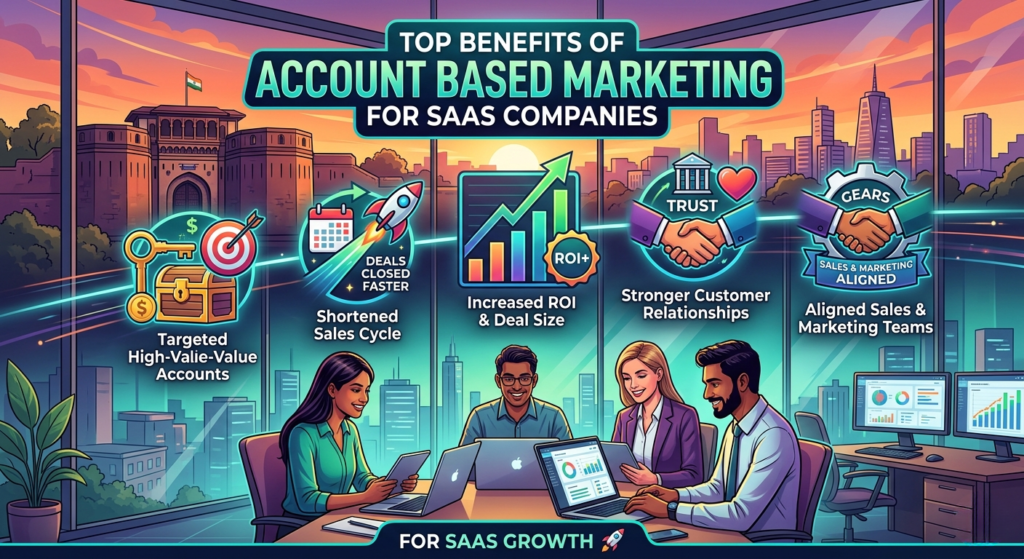
The primary benefits are significantly higher pipeline quality through pre-qualified account targeting, shorter sales cycles through simultaneous multi-stakeholder engagement, larger average contract values from relationship-driven sales processes, stronger customer retention and expansion from better-fit accounts, and improved sales and marketing alignment through shared account-level goals and metrics. Together these advantages make ABM one of the highest-ROI growth strategies available to B2B SaaS companies in 2026.
Q2. How does account based marketing work for SaaS companies specifically?
SaaS ABM identifies ideal customer accounts based on the characteristics of the company’s best existing customers, builds a focused target list, maps every stakeholder involved in the software purchasing decision within each account, creates personalized content and outreach tailored to each stakeholder’s role and priorities, engages those stakeholders across LinkedIn, email, and content channels simultaneously, and measures progress by account advancement through the pipeline rather than individual lead metrics.
Q3. What makes ABM better than traditional SaaS lead generation strategies?
Traditional lead generation optimizes for volume generating large numbers of contacts and filtering for quality afterward. ABM optimizes for fit from the beginning selecting specific high-value accounts before any marketing effort is invested. For SaaS companies where sales team capacity is finite and deal complexity is high, ABM produces more qualified pipeline per dollar of marketing investment, faster sales cycles, and larger deal values than broad-based inbound lead generation approaches.
Q4. How long does it take for a SaaS ABM strategy to produce results?
Initial account engagement and early pipeline activity typically emerges within four to eight weeks of a well-executed ABM program launch. Meaningful pipeline contribution and closed revenue from ABM-sourced accounts becomes visible within three to six months depending on typical sales cycle length. ABM is a long-game investment programs that run consistently for twelve or more months compound their results as target account relationships develop and organizational familiarity with your brand builds across the buying committee.
Q5. What types of SaaS companies benefit most from ABM?
SaaS companies with complex, multi-stakeholder purchasing processes, high average contract values, long sales cycles, and clearly defined ideal customer profiles benefit most from ABM investment. Enterprise SaaS, vertical SaaS serving specific industries, and platform SaaS with broad organizational impact across multiple departments are particularly well-suited to ABM’s relationship-intensive approach. SaaS companies with very short sales cycles and low contract values may find ABM’s investment level difficult to justify against simpler inbound alternatives.
Q6. What are the best ABM tools for SaaS companies starting a new program?
For SaaS companies launching their first ABM program, the most practical starting stack combines LinkedIn Sales Navigator for target account research and direct outreach, Bombora or a similar intent data provider for identifying in-market accounts, HubSpot or Salesforce for CRM and pipeline tracking, and a personalized video tool like Vidyard for high-engagement account-level communication. More comprehensive dedicated ABM platforms like Demandbase or Terminus become valuable investments as program maturity and target account list size justify the additional investment.
Q7. How do SaaS companies measure ABM program success?
Measure ABM success at the account level rather than at the individual lead level. Key metrics include target account engagement rate the percentage of target accounts showing active response to marketing and sales outreach pipeline generated from target accounts, average contract value of ABM-sourced deals compared to non-ABM deals, sales cycle length for target account deals, and customer retention and expansion rates for ABM-won accounts compared to accounts acquired through other channels. These metrics together demonstrate the commercial return from ABM investment more accurately than traditional marketing metrics like MQL volume or cost per lead.
Launch an ABM Strategy That Wins the Accounts That Matter Most
At CFT B2B Leads, we help SaaS companies design and execute account based marketing programs that identify high-value target accounts, engage buying committees with personalized multi-channel campaigns, and convert account-level interest into qualified pipeline and closed revenue. From ideal customer profile development and target account selection through personalized content creation, outreach execution, and pipeline reporting our team manages the complete ABM process so your sales organization can focus on closing the opportunities we generate.
Email: contact@cftb2bleads.com
Website: www.cftb2bleads.com
USA Office: 973-814-2525
Contact us today and let’s build an account based marketing strategy that wins the specific SaaS accounts your business needs to hit its revenue targets in 2026 and beyond.