
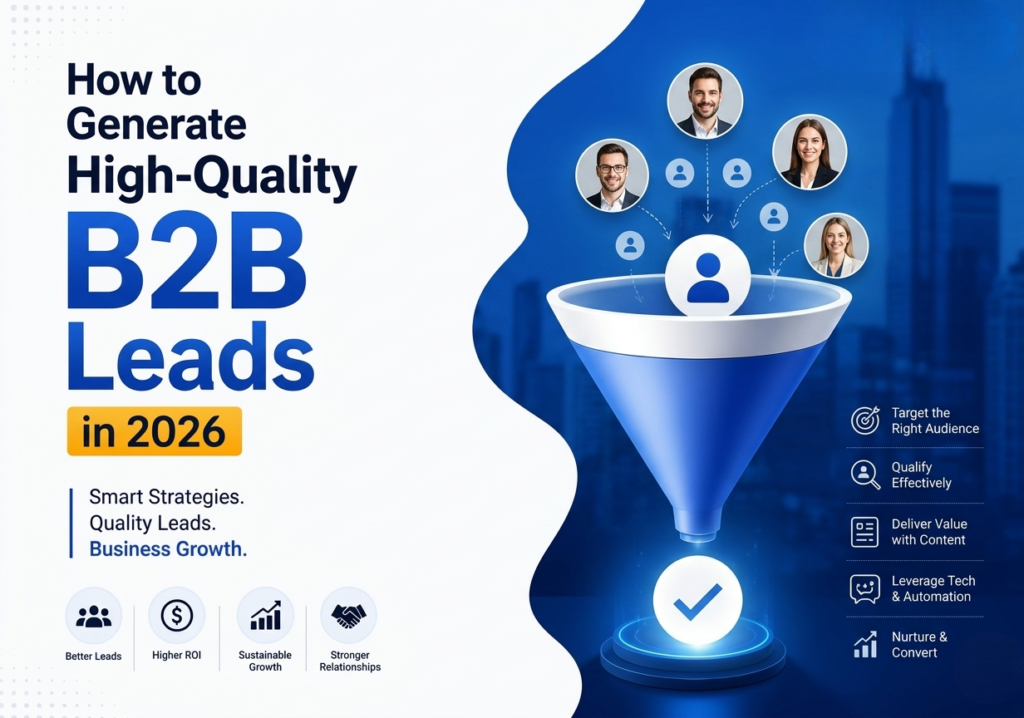
Not all leads are created equal and in 2026, the difference between high quality B2B leads and low-quality ones has never mattered more. Businesses that focus on generating high quality b2b leads consistently achieve better conversion rates and higher ROI.
Filling a CRM with contacts who never convert wastes sales team time, distorts pipeline forecasting, and creates a cycle of activity that looks productive on a dashboard but produces little actual revenue. The organizations growing fastest are not those generating the most leads. They are those generating the most qualified ones.
In 2026, B2B lead generation has evolved significantly. Buyer behavior has changed. New tools have emerged. And the techniques that reliably produce qualified B2B leads look meaningfully different from what worked just three years ago.
This guide covers the most effective B2B lead generation strategies in 2026 the approaches that consistently attract decision-makers with genuine need, real budget, and active buying intent.
Define What a High Quality Lead Actually Means for Your Business
Before implementing any lead generation technique, the most important step is establishing a precise, shared definition of what qualified B2B leads look like for your specific organization.
Without this definition, lead generation programs optimize for volume rather than quality producing large numbers of contacts that sales teams quickly identify as unsuitable, creating friction between marketing and sales that undermines both functions.
A high quality B2B lead typically meets several criteria simultaneously. The organization matches your ideal client profile in terms of industry, company size, revenue range, and geographic market. The individual contact holds relevant decision-making authority or significant buying influence within their organization. The company demonstrates some level of active need or buying intent related to your solution category. And the timing aligns reasonably with your sales cycle meaning the prospect has a reason to evaluate solutions now rather than indefinitely in the future.
Documenting this definition clearly and aligning your sales and marketing teams around it transforms lead generation from an activity metric into a revenue-contributing function. For organizations that want to take this precision even further, a structured account based marketing approach builds on this ideal client definition by identifying specific high-value companies to target ensuring every lead generation effort is directed toward the exact accounts your business has already determined represent the strongest commercial opportunity.
Content Marketing Attract Buyers Who Are Already Looking
One of the most consistently effective B2B lead generation trends in 2026 is the increased emphasis on intent-driven content that attracts decision-makers during their active research phase rather than interrupting them with outbound messaging before they are ready to engage. These strategies are specifically designed to attract high quality b2b leads instead of unqualified prospects.
Decision-makers in 2026 complete sixty to seventy percent of their buying research independently before ever contacting a vendor. They read industry publications, search for solution comparisons, study case studies, and consume educational content that helps them understand their options before committing to any conversation.
Organizations that publish authoritative content addressing the specific questions their ideal buyers ask during this research phase appear at exactly the right moment in the buying journey building credibility and trust with prospects who are actively looking for what they offer.
The content formats driving the strongest B2B lead generation results in 2026 are original research reports that provide data unavailable elsewhere, detailed comparison guides that help buyers evaluate options, practical implementation guides that demonstrate expertise, and specific case studies that make solution outcomes tangible and verifiable.
Gating this content behind a lead capture form converts organic research traffic into qualified contact data while ensuring that everyone who accesses the content has demonstrated enough interest to provide their professional details in exchange for it. Amplifying this content through a structured content syndication program places your best assets directly in front of verified business buyers across trusted third-party networks reaching decision-makers who would never have discovered your content through organic search alone and generating qualified leads from entirely new audiences without creating a single additional content piece.
LinkedIn The Highest Quality B2B Lead Source
Among all the best B2B lead generation techniques available in 2026, LinkedIn marketing consistently delivers the highest quality prospect data and the most direct access to decision-makers of any digital channel. LinkedIn remains one of the best platforms for generating high quality b2b leads.
The platform’s self-reported professional data job title, seniority level, company, industry, and company size enables targeting precision that no other channel approaches. Sales teams using LinkedIn Sales Navigator can build prospect lists filtered to exactly the professional characteristics that define their ideal buyer and reach those individuals directly through personalized outreach.
The quality advantage LinkedIn provides over most other lead generation channels comes from its audience intent. Professionals on LinkedIn are in a business mindset actively engaging with industry content, evaluating their careers, and building professional relationships. This context makes them significantly more receptive to relevant, well-positioned B2B outreach than audiences encountered through general social media or display advertising.
Organizations combining organic thought leadership content published consistently by individual team members with targeted Sales Navigator outreach and LinkedIn Sponsored Content campaigns generate a self-reinforcing lead generation system that grows more effective as brand familiarity compounds over time.
Intent Data Reach Buyers at the Right Moment
The single most impactful development in how to generate B2B leads effectively in 2026 is the mainstream adoption of buyer intent data intelligence that reveals which organizations in your target market are actively researching solutions in your category right now. Intent data helps identify companies ready to become high quality b2b leads.
Intent data platforms like Bombora, G2, and TechTarget’s Priority Engine monitor content consumption behavior across thousands of professional websites, publications, and review platforms to identify when specific companies surge in their research activity around topics relevant to your solution category.
When a target account significantly increases its consumption of content related to the problem your product solves, that behavioral signal indicates buying awareness that makes your outreach significantly more likely to land at the right time. Reaching out to an account actively researching your solution category is fundamentally different from reaching out to the same account during a period of organizational stability the timing alignment changes response rates, meeting booking rates, and downstream conversion rates measurably.
Sales teams that incorporate intent data into their B2B sales leads strategies consistently report faster sales cycles and higher close rates from intent-targeted outreach compared to demographic-only prospect selection.
Cold Email With Genuine Personalization
Cold email remains one of the highest-return B2B lead generation techniques when executed with the precision and personalization standards that 2026 decision-makers require. Personalized outreach is key to converting prospects into high quality b2b leads.
The fundamental principle that separates cold email campaigns that generate qualified B2B leads from those that generate spam complaints is specificity. Messages that open with a reference to something verifiable and specific about the recipient’s professional situation a recent company development, an industry challenge, a relevant business priority earn the attention that generic templates permanently forfeit.
Keep cold emails short. Three to four sentences with a single clear, low-friction ask performs significantly better than comprehensive product introductions that require substantial time investment to evaluate. The goal of a cold email is to start a conversation not to close a sale in the first message.
Structure multi-touch follow-up sequences of four to six contacts spaced two to four days apart. Each follow-up should introduce a new angle, insight, or question rather than simply repeating the original request. Most cold email replies arrive after the second or third contact making persistent, value-adding follow-up essential for capturing the meetings that single-touch outreach leaves unrealized. When a cold email conversation generates genuine interest from a qualified prospect, transitioning that contact into a professional appointment setting process ensures the momentum is captured and converted into a confirmed, structured sales conversation before the window of receptivity closes.
Webinars and Virtual Events High-Intent Lead Generation
Among qualified B2B leads generation strategies that consistently produce warm, sales-ready prospects, webinar marketing stands out for one specific reason every registrant has actively chosen to invest time in your topic. Webinars are highly effective for nurturing high quality b2b leads.
This self-selection creates a level of demonstrated interest and qualification that most other lead generation formats cannot match. Webinar attendees have already engaged with your content, experienced your expertise firsthand, and formed an initial impression of your organization’s knowledge and credibility before your sales team ever reaches out.
Post-webinar follow-up sequences that reference the specific content discussed sending recordings, sharing relevant resources, and asking questions that continue the conversation consistently convert a higher percentage of leads into active sales opportunities than equivalent follow-up from lead sources with no prior content engagement.
Hosting webinars on topics that directly address the most pressing challenges your ideal clients are trying to solve right now attracts the audience most likely to benefit from your solution creating a natural alignment between content interest and commercial opportunity that makes every post-event sales conversation warmer and more productive.
Frequently Asked Questions (FAQ)
Q1. How do you build a mobile app from scratch in 2026?
Building a mobile app from scratch involves seven key stages validating the problem and market, defining a focused MVP feature set, choosing your platform and technology stack, designing the user interface and experience, developing and testing iteratively, submitting to app stores, and monitoring and improving after launch. Each stage builds on the previous one, and skipping validation and design work before development consistently produces the most expensive and time-consuming problems.
Q2. How much does it cost to build a mobile app in 2026?
Mobile app development costs in 2026 range from approximately fifteen thousand dollars for simple applications to over two hundred and fifty thousand dollars for complex enterprise-grade products. The primary cost drivers are feature complexity, platform approach native versus cross-platform development team location and experience level, and the quality and depth of design work preceding development. Cross-platform development with Flutter or React Native reduces cost by thirty to fifty percent compared to building separate native applications for iOS and Android.
Q3. How long does it take to build a mobile app?
A focused MVP with a professional development team typically takes three to six months from concept to app store submission. Simple applications with limited features can launch in six to eight weeks. Complex applications with extensive backend integration, multiple user roles, and advanced functionality can take nine to eighteen months. Thorough planning, clear requirements, and professional design work completed before development begins consistently reduce total development time compared to starting development without this preparation.
Q4. Should I build a native app or use a cross-platform framework?
For most businesses and first-time app builders in 2026, cross-platform development with Flutter or React Native is the recommended approach. It reduces development cost and time by thirty to fifty percent while delivering user experiences that are indistinguishable from native for the majority of use cases. Native development is the right choice for applications requiring deep platform-specific capabilities advanced AR features, complex hardware integrations, or performance-critical real-time processing that cross-platform frameworks cannot fully access or optimize.
Q5. What are the best tools for building a mobile app in 2026?
The most widely used and professionally recommended tools include Flutter for cross-platform development, Swift with Xcode for native iOS development, Kotlin with Android Studio for native Android development, Figma for UI and UX design, Firebase for backend services and analytics, and TestFlight and Google Play Console for beta distribution and testing. These tools represent the current professional standard across the mobile development industry.
Q6. Do I need coding skills to build a mobile app in 2026?
Technical coding knowledge is required for custom native and cross-platform development. No-code and low-code platforms including Bubble, Adalo, and FlutterFlow allow non-technical founders to build functional mobile applications without writing code suitable for testing ideas and reaching early users but limited in the complexity and customization achievable compared to professionally coded applications. For production-quality applications intended for serious commercial use, working with professional developers or investing in learning the relevant development skills produces substantially better long-term outcomes.
Q7. How do I make my mobile app available on both Android and iOS?
Cross-platform frameworks like Flutter and React Native build a single codebase that deploys to both the Apple App Store and Google Play Store from the same development project. Native development requires building and maintaining separate codebases for each platform. Both approaches require separate developer accounts an Apple Developer account for iOS App Store distribution and a Google Play Developer account for Android distribution and compliance with each platform’s review guidelines before your application becomes publicly available.
Generate the High Quality B2B Leads Your Sales Team Deserves
At CFT B2B Leads, we help B2B companies build and execute lead generation programs that attract genuinely qualified prospects, fill pipelines with decision-makers who are ready to engage, and convert lead generation investment into measurable revenue growth. From ideal client profile development and intent-driven targeting through multi-channel outreach execution, content strategy, and pipeline reporting our team manages the complete process so your sales organization benefits from lead generation done at the highest professional standard.
Email: contact@cftb2bleads.com
Website: www.cftb2bleads.com
USA Office: 973-814-2525
Contact us today and let’s build a B2B lead generation strategy that fills your pipeline with the high quality prospects your business needs to grow revenue consistently and predictably in 2026.